
Australia's Prime Minister Tony Abbott on Friday said he will sign an agreement with India to sell uranium for non-weapon use. "Prime Minister Modi and I will today sign a nuclear cooperation agreement that will finally allow Australian uranium to India," he said while addressing a meeting, organised by industry chambers including CII and Ficci.


Leaders of the two countries, however, did discuss on Pakistan's nuclear safety and security which is an ongoing discussion.

Pakistani Prime Minister Shehbaz Sharif has briefed Saudi Crown Prince Mohammad bin Salman on Pakistan's diplomatic efforts to de-escalate the situation in West Asia. This follows Pakistan's offer to host talks between the US and Iran to resolve the ongoing conflict.

'The next two to three weeks will not be decided in Washington.' 'They will be decided in Tehran, in whatever calculation Iran makes about the costs of continued resistance against the costs of appearing to have yielded.'
The Indian Embassy in Riyadh has confirmed that an Indian national was injured but no fatalities occurred in a projectile incident in Saudi Arabia. The injured individual is receiving treatment at a government hospital.

The Indian embassy in Saudi Arabia has confirmed that one Indian national was injured in a projectile incident in Al Kharj, while clarifying that there were no Indian fatalities. The embassy is providing assistance and is in contact with Saudi authorities.
An Indian national was killed in Saudi Arabia after a projectile struck a residential area in Al-Kharj Governorate. The incident also resulted in the death of a Bangladeshi national and injuries to twelve others.
Pakistani Prime Minister Shehbaz Sharif is actively engaged in diplomatic efforts to de-escalate tensions in West Asia, offering to host talks between the US and Iran and engaging with regional leaders to promote peace and stability.

Pakistan's Prime Minister Shehbaz Sharif has offered to host talks between the US and Iran to help resolve the ongoing conflict in the Middle East, following reports of Pakistan's involvement in backchannel diplomacy.

India and Canada are negotiating a long-term uranium supply agreement worth $2.8 billion. They are also exploring expanded civil nuclear cooperation after the passage of the SHANTI Bill.

US President Donald Trump announced a new global levy on imported items, resulting in a lower tariff rate for India, following a Supreme Court verdict against his previous sweeping tariffs.

Democratic Progressive Azad Party chairman Ghulam Nabi Azad expressed deep concern over the escalating conflict in the Middle East, urging restraint and diplomacy from all parties involved.

We cannot simply have a 60-65 per cent import dependency in LPG, the bulk of which comes from just one volatile region -- West Asia, points out R Jagannathan.

Trump repeated the assertion that Sharif had claimed he saved "25 million lives" when he stopped the war between India and Pakistan.

Pakistan's Prime Minister Shehbaz Sharif has offered to mediate between the US and Iran to de-escalate the ongoing conflict in West Asia, following a joint US-Israel attack on Iran. Sharif has been in contact with Saudi Arabia, the UAE, and other nations to promote dialogue and diplomacy.
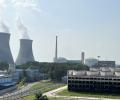
Extending its nuclear power plant supply relationship with India to the non-nuclear sector, Russia's integrated atomic power major Rosatom State Corporation is in talks for a 50:50 additive technology joint venture.

The British government has called for a negotiated solution to prevent further escalation of conflict in the Middle East following joint strikes by the US and Israel on Iran, emphasizing the safety of UK nationals and the need to prevent Iran from developing nuclear weapons.

'India's ties with Israel have to do with defence and general technology.' 'The war changes nothing in what India and Israel hope to get from the relationship.' 'It's not as though India will get significantly more benefits from Iran if India abandons Israel at this time.'
Government sources said amendments were being considered to the Atomic Energy Act to allow private sector participation and the Civil Liability for Nuclear Damage Act to limit the liability on suppliers of equipment to build atomic energy plants.
If the UPA government signs the nuclear deal with onerous conditions, its credibility will be undermined. If the deal collapses, the UPA stands to become the nation's laughing stock.
Pakistan's Prime Minister Shehbaz Sharif has engaged in extensive diplomatic efforts to de-escalate the conflict in West Asia, offering to host talks between the US and Iran and engaging with leaders from Saudi Arabia, Qatar, Malaysia, the UK, China, and the European Union.

16 days into the war, US forces were already running out of ground-attack missiles and Israel is about to expend its entire Arrow interceptor missiles by end March. To be sure, the Iranians are watching closely and that explains their defiant stance that 'Iran will end the war when it decides to do so and when its conditions are met', notes Ambassador M K Bhadrakumar.
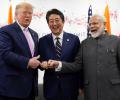
Prime Ministers Modi and Abe enjoyed a close and empathetic relationship and this certainly gave a sustained momentum to the India-Japan strategic partnership. It is necessary for India to reach out and engage with his successor as early as possible, advises former foreign secretary Shyam Saran.

The powerful United Nations Security Council on Monday unanimously adopted a resolution that endorses the landmark nuclear deal between Iran and six world powers.
Amidst growing concern in the United States Congress that the India-US nuclear deal is in limbo, the Barack Obama administration last week attempted, albeit weakly, to assuage the angst that Washington has been taken for a ride by New Delhi. Parliament's nuclear liability law has left American companies hanging after all of the capital they extended in pushing the accord through both the US Senate and the House of Representatives.

Senator John Cornyn, Senate Majority Whip for the 114th Congress, in a letter to Obama, has said "it is ill-advised" to pursue any civil nuclear agreement with Pakistan.

What we are watching is something different: A fog manufactured and maintained by the people who started the war, so that the question of why it was started never has to be answered, observes Prem Panicker in his must read blog on the war in the Middle East.

The United States has lifted most of its sanctions against Iran after a UN watchdog reported that Tehran had complied with a nuclear weapons deal.

The LPG squeeze on India's restaurant sector is the quotidian face of a deeper crisis.

The meeting of the foreign ministers of the P5+1 nations aimed to smoothen out major bumps in reaching a nuclear deal with Iran has ended with a positive note.

When missiles fly in this region, they are never just aimed at military targets.

'We had to convince our people that we were doing nothing that would erode our strategic programme. We were all the time arguing that we are not doing anything, which will remotely impact on our strategic programme.'

Alliances fight wars effectively only when they share an endgame. If Israel acted without US knowledge, then the military alliance is operating without real coordination at the level of strategic targeting. Neither picture is reassuring in a war that is no longer regional in its consequences. Prem Panicker continues his must read daily blog on the Gulf War.

Egypt, Pakistan, Saudi Arabia and Turkey met in Islamabad in what analysts say is the formal opening of a new diplomatic formation that could reshape the post-war regional order. Their immediate goal is a ceasefire; their larger ambition is to ensure that neither Iran nor Israel emerges from this war in a dominant position. Pakistan's foreign minister then flew directly to Beijing and mooted a Chinese role as guarantor of any eventual agreement. Prem Panicker continues his must read daily blog on the Gulf War.

External Affairs Minister S Jaishankar and US Secretary of State Marco Rubio discussed cooperation in trade, critical minerals, nuclear energy, and defence, reaffirming commitment to a free and open Indo-Pacific.

A pact between the NPCIL and Westinghouse to build six power reactors in Andhra Pradesh is unlikely to be signed.

The deal involves Iran accepting curbs on its nuclear programme in return for sanctions relief, but many of the critical, politically-charged details are still awaited.

Israel has for more than two decades and several US presidencies worked to draw the United States into a full-scale war with Iran. Having finally achieved that, the last thing it wants is Trump declaring victory and going home, as he is prone to do. Ali Larijani was the figure most capable of handing Trump a negotiated exit with something to show for it. Without Larijani, the road to an exit gets considerably narrower. Prem Panicker continues his must read daily blog on the Gulf War.
